Our Range








Hamptons Bathroom Vanity: How to Create a Timeless Coastal Bathroom
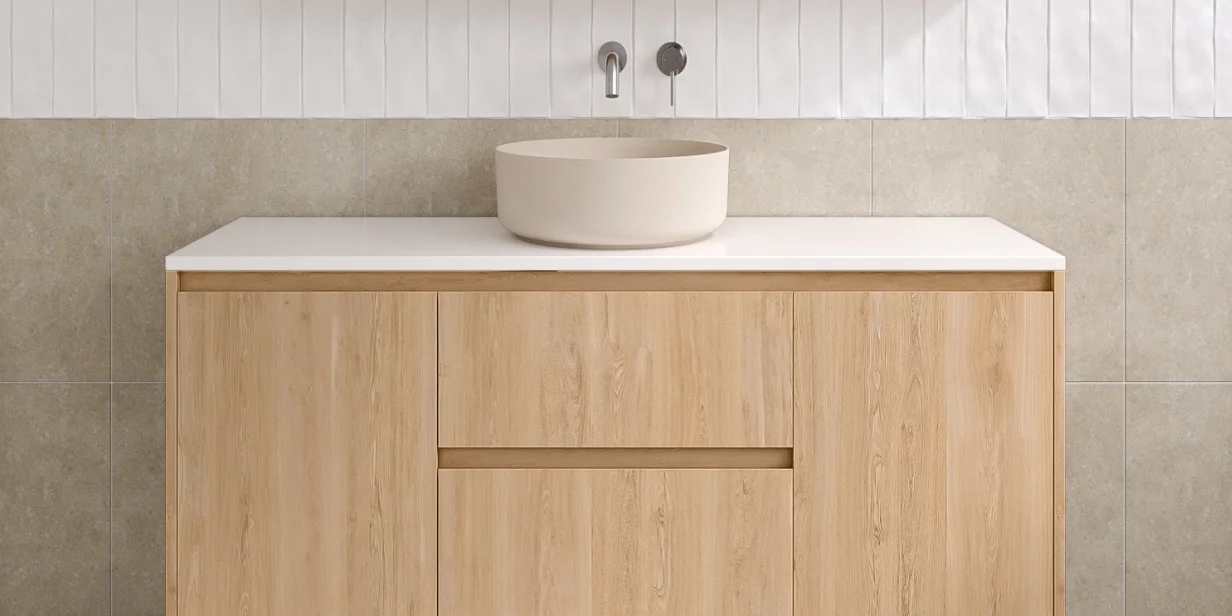
With its classic detailing, soft colour palette, and natural materials, a Hamptons bathroom vanity brings an understated elegance to the home. Its relaxed coastal character feels particularly at home in New Zealand interiors, offering a timeless balance of style, comfort, and practicality.
The vanity is often where that character is first established. It is usually the largest piece of joinery in the room, and its profile, colour, and finish set the tone for everything around it. The right one holds the balance between traditional detailing and contemporary function, so the room feels relaxed and polished without tipping into reproduction.
In this guide, we cover how to choose and style a Hamptons bathroom vanity, from cabinetry and colour to vanity tops, basins, and tapware. Along the way, we look at the surrounding finishes and the design choices that suit your space, your needs, and the way you use it.
What Is a Hamptons Bathroom Vanity?

Inspired by the coastal homes of New York’s Long Island, a Hamptons bathroom vanity combines traditional design with a relaxed, understated aesthetic. While interpretations may vary, the style is typically recognised by a few defining features:
- Light or natural colour palettes. White and soft neutrals are the starting point, with timber, greige, and muted coastal tones also common.
- Classic cabinetry profiles. Shaker-style doors and drawer fronts, with their recessed centre panels, are the most recognisable feature. Panelling, simple mouldings, and fluted or reeded detailing also appear.
- Stone or stone-look vanity tops. Marble, travertine, and porcelain or sintered stone with soft veining all suit the style.
- Traditional detailing balanced with contemporary function. Soft-close drawers, integrated plumbing cut-outs, and practical storage sit behind a classic face.
Modern interpretations tend to be more streamlined than traditional Hamptons cabinetry, with slimmer profiles, fewer mouldings, and wall-hung rather than floor-standing forms. There is no single prescribed Hamptons vanity design. Proportions, materials, and detailing can all shift depending on the wider bathroom, and a Hampton bathroom vanity in a compact ensuite will look quite different to one in a generous main bathroom.
Choosing the Right Hamptons-Style Vanity for Your Bathroom

While style matters, choosing the right Hamptons bathroom vanity starts with understanding your space.
Measure your space. Look at the available wall space, the clearance in front of the vanity, and where doors, showers, and toilets sit. A vanity that crowds the room will undermine the airy feel the Hamptons look depends on.
Consider who uses the bathroom. A main bathroom shared by two adults has different needs than a guest powder room. Think about how much storage each person needs and whether drawers or cupboards suit what you will be storing.
Choose between a single or double basin. If multiple people use the bathroom at once and space allows, a double basin can make busy mornings easier. In smaller bathrooms, a single basin with more bench space is often the more practical choice.
Relate the proportions to the room. The vanity’s width and depth should feel in scale with the walls, mirror, and lighting around it. Larger rooms can carry wider joinery; smaller rooms usually benefit from a lighter form.
Balance detailing with practicality. Shaker profiles and recessed panels collect less grime than heavily carved mouldings, which makes them easier to clean. When comparing Hampton bathroom vanities, look at drawer configuration, internal storage, and how easy the surfaces are to wipe down, not just the front elevation.
These bathroom vanity design considerations also make the decisions in the sections below easier.
Find the Right Colour for Your Hamptons Bathroom Vanity

White is the colour most associated with the style, but Hamptons bathroom ideas extend well beyond it.
- Classic whites and soft neutrals remain the most versatile choice. They reflect light, suit almost any tile or benchtop, and create the crisp, fresh feel many people want from a coastal bathroom vanity.
- Warm beige, greige, and muted coastal shades such as soft sage or washed blue-grey add depth without breaking the calm palette.
- Natural timber offers a warmer, more contemporary interpretation. Pale oak tones are a natural fit for a modern Hamptons bathroom, bringing texture that balances white walls and stone.
- Deeper colours such as navy or charcoal work where you want stronger contrast, particularly when the walls and floors stay light.
Whatever the colour, consider how it works with your flooring, wall tiles, and natural light. A white that looks crisp in a bright, north-facing room can feel cold in a bathroom with limited natural light, where a warmer white or timber finish may work better. Hamptons-style bathroom ideas don’t have to rely on bright white; many of the most successful coastal bathroom ideas use layered neutrals instead.
Select a Vanity Top and Basin

The vanity top is the surface you see and touch most, so it has a big influence on how the room feels.
Natural stone brings individual character. Our travertine vanity tops are crafted from solid travertine, with soft, creamy tones and natural variation, so each piece is one of a kind. Natural stone should be sealed to protect its finish.
Engineered stone and solid surface offer a more consistent, low-maintenance alternative. Our Carrara Marble solid surface vanity tops give a realistic marble look in a durable, scratch-resistant, easy-to-clean material.
Light-coloured surfaces support a classic coastal aesthetic, and veining and texture add depth to a predominantly neutral room. Soft grey veining suits cooler palettes; travertine’s warmer tones pair well with timber and greige.
Countertop or integrated basins? A countertop basin sits on the vanity top and becomes a feature in its own right, while an integrated or undermount configuration keeps the surface flatter and easier to wipe down. For a Hamptons bathroom vanity, soft, classic basin shapes tend to work best. Our Willow Basin in almond has a classic oval top and gently curved base, and the Celine Basin has a rounded-square profile in the same warm tone.
Think about proportion, too. A basin should leave usable bench space on either side and sit comfortably within the vanity’s depth. When choosing your bathroom vanity design, plan the top and basin together.
Pair Your Vanity With the Right Tapware and Hardware

The choice of tapware and cabinet hardware can make a significant difference to the overall character of a Hamptons bathroom. For a traditional look, provincial-inspired mixers with gentle curves and decorative handles, such as our Kingsley Basin Mixer, introduce a sense of classic elegance. Alternatively, the streamlined silhouette of our Elysian Basin Mixer lends itself to a more contemporary interpretation of the style.
Finish matters as much as form:
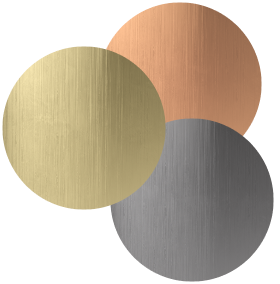
- Brushed brass and other warm metallics add warmth against white cabinetry and stone and suit the more relaxed side of Hamptons bathroom ideas.
- Brushed nickel and chrome give a cooler, more understated result that complements greys, whites, and coastal blues.
Coordinate tapware with cabinet handles and pulls, towel rails, robe hooks, and shower fixtures. A consistent finish throughout makes a coastal-style bathroom feel considered, while mixing too many metals can make the room look busy. If you do combine finishes, limit it to two and repeat each one more than once.
Create a Cohesive Hamptons Bathroom Around the Vanity
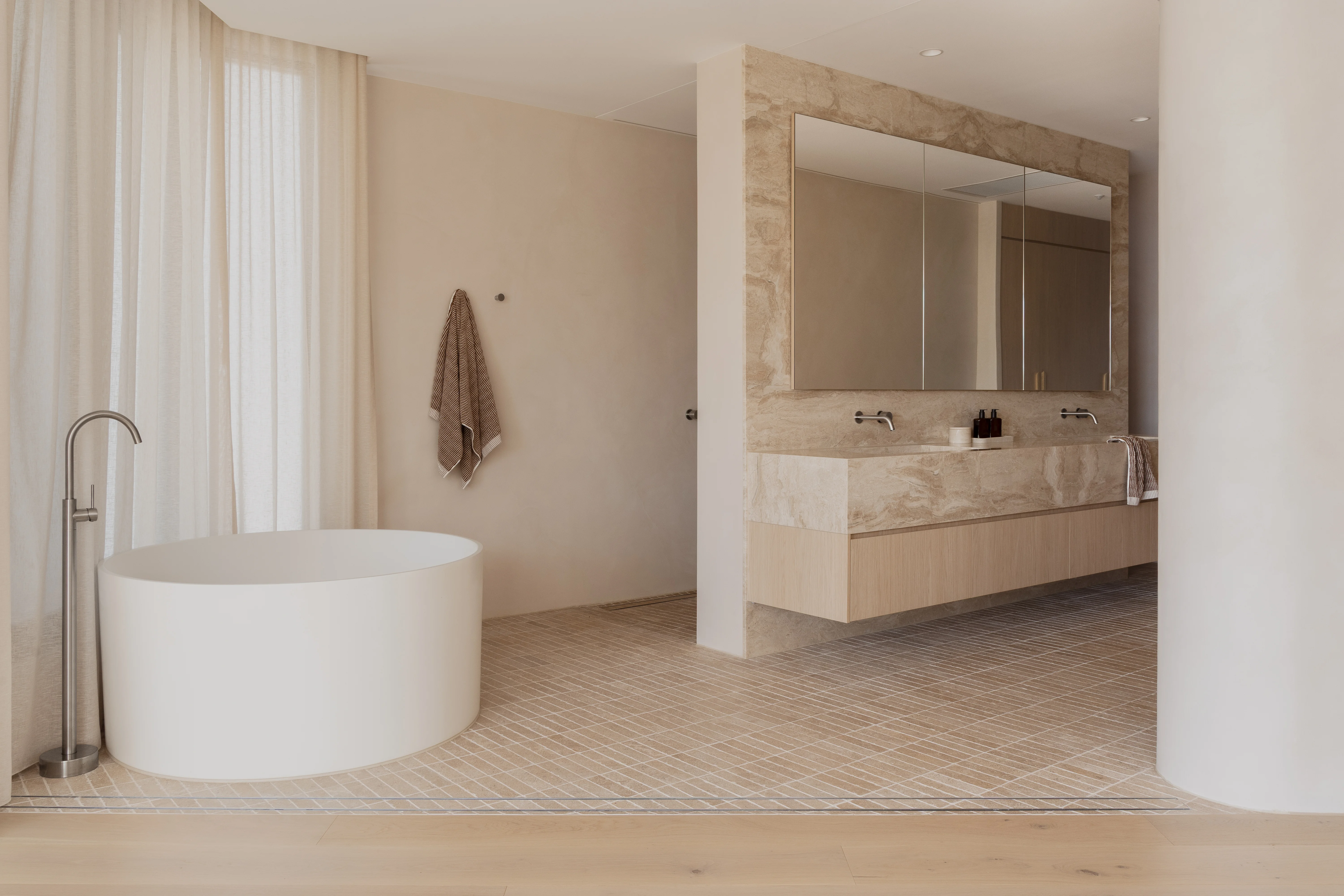
Once the vanity is selected, the surrounding materials should support it rather than compete.
- Wall and floor tiles. Subway tiles, gloss finishes, and soft-toned stone-look tiles suit the classic look; larger formats and subtle textures lean modern.
- Mirrors and lighting. Framed or arched mirrors and warm wall lights at either side of the vanity are characteristic of Hamptons bathroom design.
- Bath and shower fixtures. Match the style and finish of your shower and bath tapware to the basin mixer.
- Natural textures and materials. Timber, linen, rattan, and woven baskets bring in the relaxed coastal bathroom feel.
- Colour palette. Keep to a restrained palette of two or three main tones, with accents introduced through accessories.
- Storage and accessories. Open shelving, towel ladders, and coordinated accessories add function without clutter.
Repeating materials, colours, and finishes throughout the room helps the vanity feel integrated rather than like an isolated feature, while creating a cohesive Hamptons aesthetic. A travertine vanity top paired with stone-look floor tiles, or brushed brass tapware complemented by matching cabinet pulls and a towel rail, brings the look together.
Modern Hamptons Bathroom Ideas
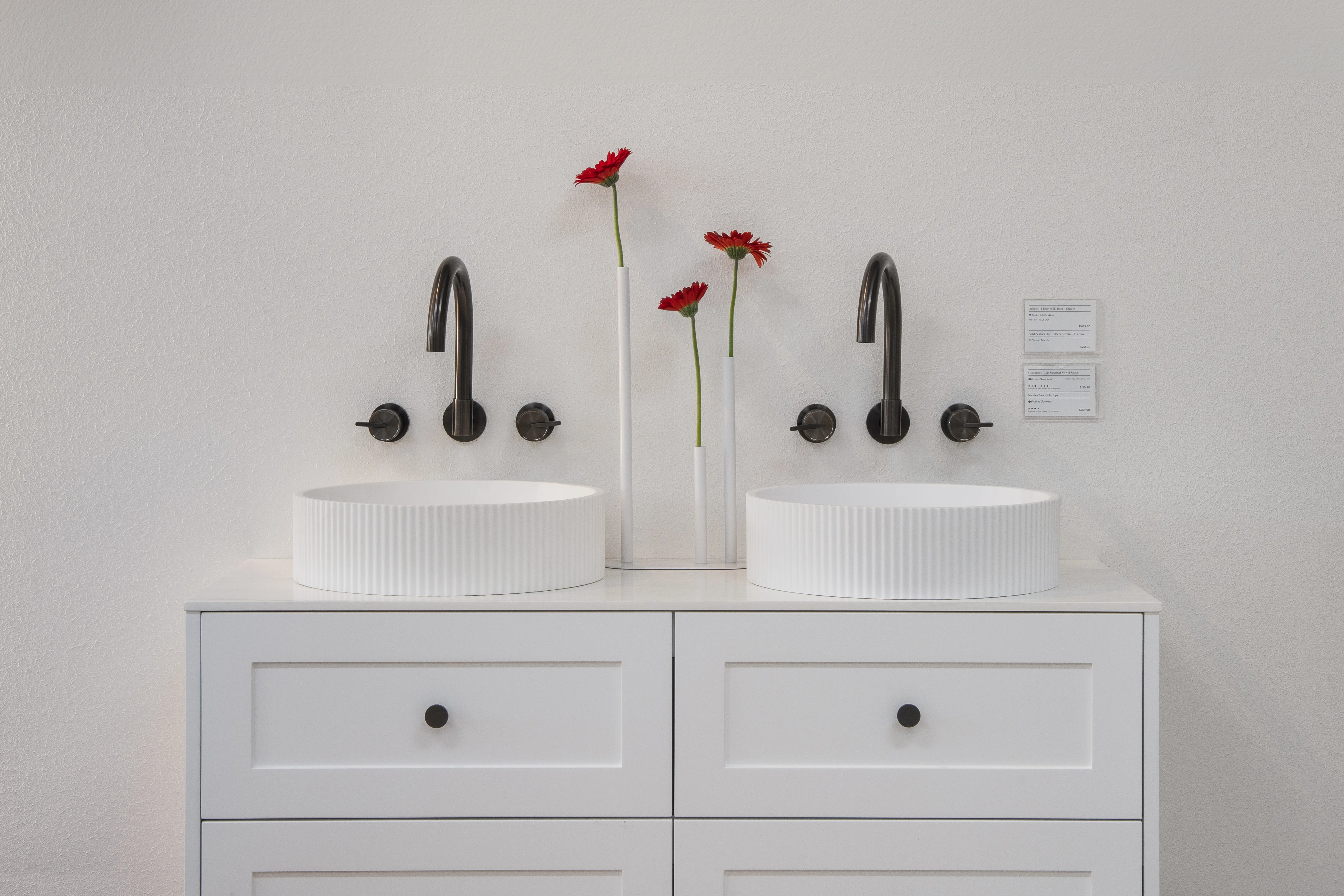
A modern Hamptons bathroom is best understood as an evolution of the style rather than a separate aesthetic. It keeps the light palette, natural materials, and coastal ease but pares back the detailing so the room doesn’t feel overly traditional.
- Simplify cabinetry profiles. Choose slimmer shaker frames, flat fronts with subtle fluting, or curved forms over heavily panelled joinery.
- Introduce natural timber or warmer neutrals. Oak cabinetry or a warm white softens the crispness of a classic all-white scheme.
- Use larger-format or subtly textured tiles. Fewer grout lines and gentle surface texture feel contemporary while staying in the coastal palette.
- Keep decorative detailing restrained. Let one or two elements, such as a fluted vanity front or an arched mirror, carry the character.
- Combine classic vanity proportions with contemporary fixtures. A shaker vanity paired with minimal tapware is one of the simplest bathroom vanity ideas for bridging old and new.
These Hamptons-style bathroom ideas work just as well in a new build as a renovation, and they adapt easily to broader coastal bathroom ideas.
Common Mistakes When Choosing a Hamptons Bathroom Vanity
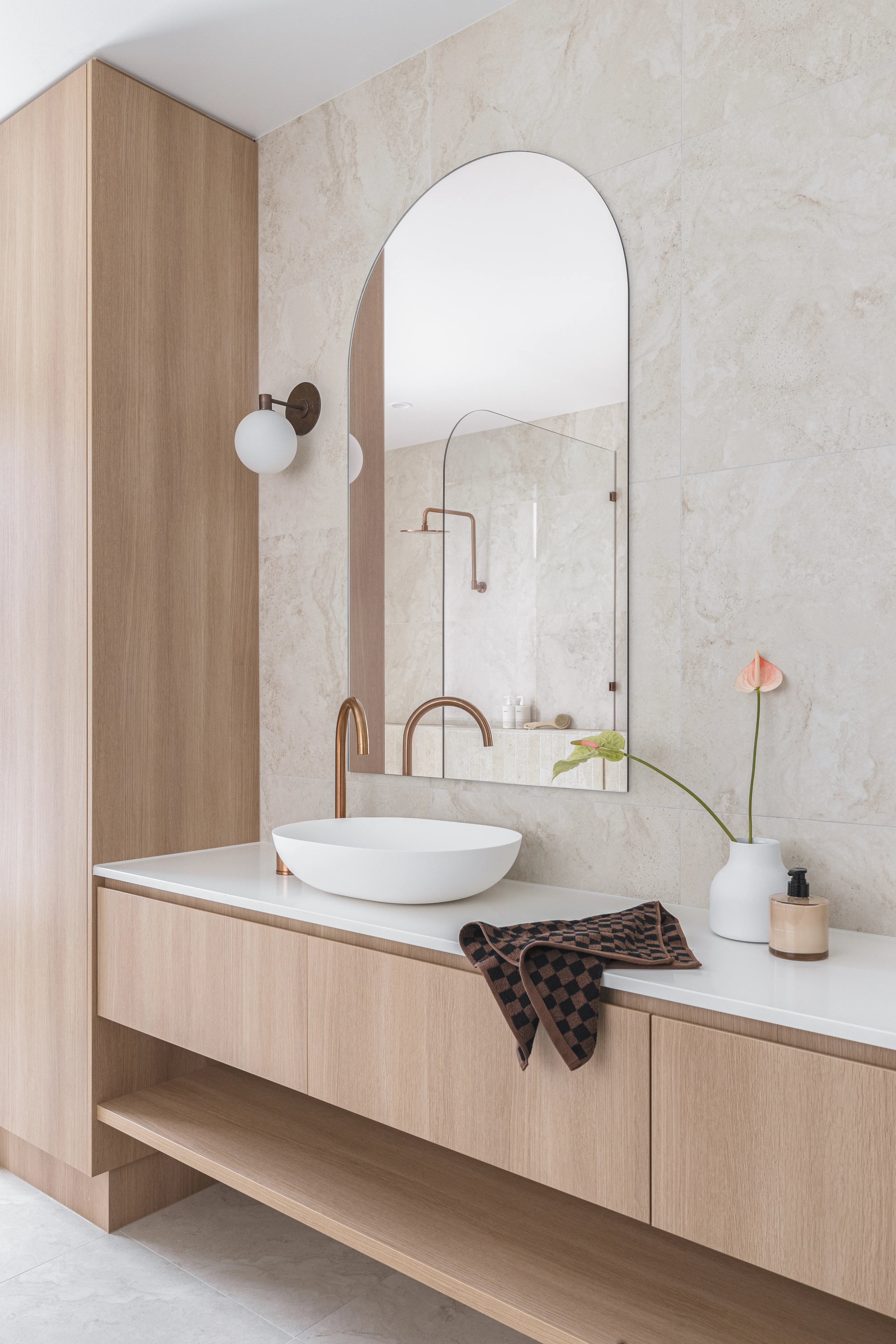
Choosing based on aesthetics alone. A beautiful vanity in the wrong size will make the bathroom feel cramped or unbalanced. Start with the room’s proportions, then choose the style.
Overusing decorative detailing. Mouldings, panelling, ornate hardware, and patterned tiles all at once can tip a Hamptons bathroom into pastiche. Be selective.
Using too many competing finishes. Several metal finishes, multiple timber tones, and different shades of white can conflict with one another. Keep the palette tight.
Choosing an impractical size or storage configuration. Consider what needs to be stored and how the bathroom is used daily, and choose drawers, cupboards, and basin numbers to suit.
Assuming everything needs to be white. Timber, greige, and muted coastal tones can deliver a more characterful Hamptons bathroom design.
Selecting the vanity in isolation. The vanity, top, basin, tapware, and surrounding materials work as one. Choosing them together avoids mismatched proportions and finishes and leads to better bathroom vanity design overall.
Creating a Timeless Hamptons Bathroom
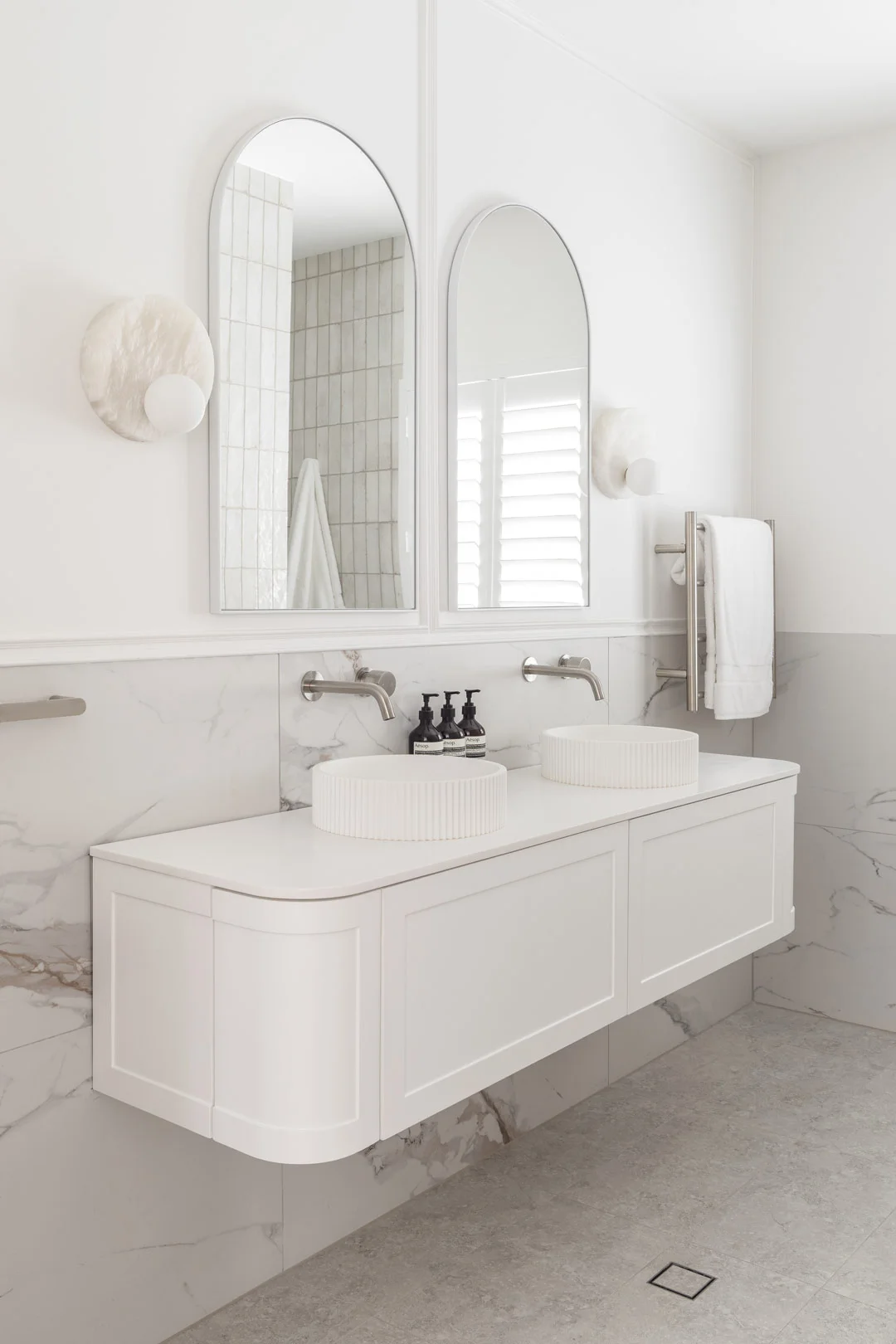
A successful Hamptons bathroom balances classic detailing with practical design. The Hamptons bathroom vanity can set the direction for the wider room, but its cabinetry, materials, tapware, tiles, and lighting all need to work together for the look to hold.
Rather than trying to recreate every traditional Hamptons feature, be selective and choose elements that suit your home’s architecture and your own style. A Hamptons-style bathroom that reflects how you live will feel more relaxed and personal and is more likely to stand the test of time than one designed around a checklist. Get the balance right, and the result is a coastal bathroom that feels light, calm, and considered for years to come.
What is a Hamptons-style bathroom vanity?
A Hamptons-style vanity pairs traditional cabinetry details, like shaker doors and drawer fronts, with a light or natural colour scheme and a stone or stone-look top. It captures the easy, coastal feel of the Hamptons look, bringing together classic design and everyday practicality.
What colour should a Hamptons bathroom vanity be?
White and soft neutrals are the traditional pick, though warm beige, greige, natural timber, and gentle coastal tones also fit the style. Darker shades, such as navy or charcoal, suit bathrooms where you want more contrast against pale walls and flooring.
Can a wall-hung vanity work in a Hamptons bathroom?
Yes. Wall-hung vanities lend themselves to a more contemporary take on the style. With shaker detailing and a pale palette, they hold on to the Hamptons feel while opening up the floor space and making cleaning simpler.
What vanity top works with a Hamptons bathroom vanity?
Marble, travertine, and other natural stones suit the style, as do stone-look options like engineered stone and solid surface. Pale tones with soft veining work best for a classic coastal finish. Natural stone gives each top its own character but needs periodic sealing, while engineered stone and solid surface offer a more uniform look with less upkeep.
How do you make a Hamptons bathroom look modern?
Pare back the cabinetry detailing, bring in warmer neutrals or natural timber, select contemporary tapware, and use coastal elements sparingly. Large-format or lightly textured tiles can also give the space a more current feel.
What size vanity is best for a Hamptons bathroom?
Size comes down to the room rather than the style. Base your choice on the wall space you have, who’ll be using the bathroom, your storage needs, and whether a single or double basin suits you best.
For further inspiration, read these blogs: